
M&A Trends in the Value-Added Warehousing Market | Stephens

Stephens will never ask clients or prospective clients for personal or financial information, or provide investment advice, via social media, or WhatsApp.

If you have any questions or concerns about someone from Stephens contacting you, please call your Stephens Representative or reach out to us via our Contact Us form.

Who We Are

What We Do

We provide investment banking, research, sales and trading, asset and wealth management, public finance, insurance, private capital, and family office services.

About Us

We are a family-owned financial services firm that values client relationships, long-term stability, and supporting the communities where we live and work.

The Stephens Story

The idea of family defines our culture, because each of us knows that our reputation is on the line as if our own name was on the door.

Leadership

Our reputation as a leading independent financial services firm is built on the stability of our longstanding and highly experienced senior executives.

Impact Initiatives

We are committed to bettering the communities where we live and operate. We do this by supporting corporate philanthropy, economic and financial literacy advocacy, and professional success.

Our Brand Ambassadors

Stephens is proud to sponsor the PGA TOUR, LPGA Tour, and PGA TOUR Champions careers, as well as applaud the philanthropic endeavors, of our Brand Ambassadors.

Stephens & Atlassian Williams F1 Team

Stephens is the official investment banking partner of Williams Racing, one of the most winning teams in F1 history. We share that tradition of success.

Making Connections

We host many highly informative meetings each year with clients, industry decision makers, and thought leaders across the U.S. and in Europe.

Our Businesses

Capital Management

We provide fiduciary investment strategies to public-and private-sector institutional clients through asset allocation, consulting, and retirement services.

Fixed Income Sales & Trading

Decades of proven performance and experience in providing tailored fixed income trading and underwriting services to major municipal and corporate issuers.

Institutional Equities and Research

Proven industry-leading research, global market insights, and client-focused execution.

Insurance

Customized risk management, property & casualty, executive strategies and employee benefits solutions that protect our clients over the long term.

Investment Banking

We assist companies with accessing capital through innovative advisory and execution services that help firms achieve their strategic goals.

Stephens Private Capital

We have been a trusted and reliable source of capital for private companies for over 70 years.

Private Wealth Management

Our experienced Private Client Group professionals develop customized investment strategies to help clients achieve their financial goals.

Public Finance

We are a trusted municipal advisor with proven expertise in public financings. We also work with clients in negotiated and competitive municipal underwritings.

Article Icon

Market Trends

M&A Trends in the Value-Added Warehousing Market

Dec 22, 2025

Over the course of the last several years, M&A activity in the Value-Added Warehousing (“VAW”) sub-sector of the Transportation & Logistics (“T&L”) industry has ramped considerably. In this article, we reflect on some of the key factors that have helped drive this market interest and share perspectives on some important themes for industry participants, now and in the years ahead.

Secular Trends: Macroeconomic Factors on VAW

At a high-level, some buyers may view the Value-Added Warehousing space as uniquely positioned to possibly benefit from several potential long-term macroeconomic tailwinds.

Near Shoring / Re-Shoring:

  • A combination of political pressures, supply chain risk management strategies and cost savings initiatives have created a powerful incentive to relocate production closer to the ultimate U.S. user. As a result, related outsourced services, such as VAW, are experiencing growth. According to GXO Logistics, each 1% of trade that moves to North America and Europe from another country represents a $1B increase in the total addressable marketplace for VAW services[1].

Commercial Channel Shifts:

  • The shift of commerce from physical locations to online has changed the way products are stored, handled and distributed through both business-to-consumer (“B2C”) and business-to-business (“B2B”) channels. According to CBRE, replicating a brick & mortar retail distribution network with an e-commerce distribution strategy requires ~3x the amount of real estate[2]. Given this increased access to demand and larger relative footprint, e-commerce distribution strategies also require more personnel and more robust technology to manage additional SKU counts, often tipping the scales in favor of using an outsourced provider.

Outsourcing:

  • Relative to performing warehouse services internally, using an outsourced provider can drive meaningful efficiencies for shippers. Third-party providers help their clients reduce costs by leveraging a trained and experienced workforce and sharing in procurement cost savings on items such as real estate, temporary labor staffing, racking and material handling equipment. Outsourcing also allows clients to refocus on core competencies, resulting in leaner, more streamlined operations. Outsourced providers’ technology solutions are often specialized for the warehousing task at hand and improve inventory management and turnover, as well as flex with changes in seasonal freight patterns. Better performing warehousing operations lead to improved customer service, driving the potential for improved retention and revenue growth for shipper clients. As of 2021, just 32% of the $456 billion global VAW TAM was outsourced to third party providers, with the balance handled internally by shippers[3]. In the years ahead, key industry participants expect this penetration rate to increase as the efficiencies associated with outsourcing become more apparent[4].

The combination of these factors is fueling growth in the VAW subsector of the T&L industry. In the 5 years leading up to Covid-19, the Value-Added Warehousing space grew at a 6% CAGR[5]
Through 2027, the global industry is forecast to grow at an 8% CAGR[6]. Given the potential organic growth, market interest levels could grow in the years ahead.

Sticky, Visible Business

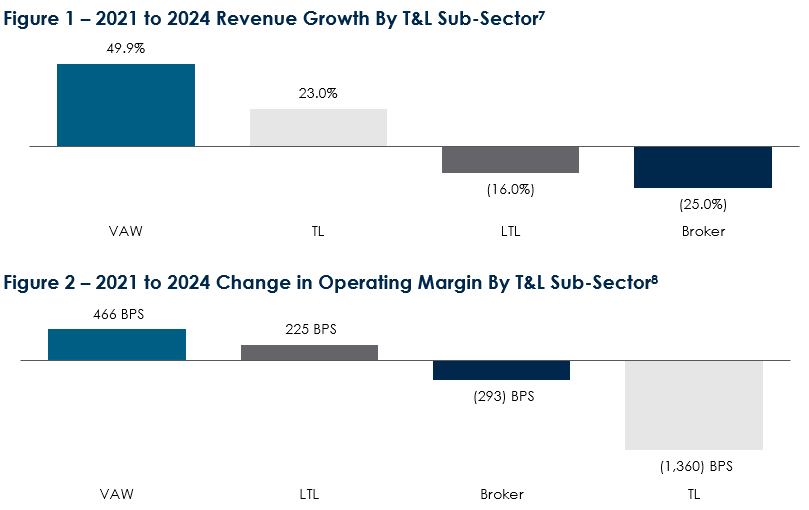
Most VAW services are contracted with clients, oftentimes on a multi-year basis. Contract conventions vary by end-market and service, but in general, tend to provide for high-levels of revenue visibility as compared to other, more transactional types of logistics services, such as trucking, brokerage and freight forwarding. Levels of integration with clients tend to be high, with new project lead-times often being 6 months or more to accommodate for customized service preferences. This dynamic could result in significant switching costs, potentially leading to strong levels of client retention. Over the course of the most recent freight market downturn, Value-Added Warehousing models have exhibited strong levels of growth and margin stability relative to other T&L sub-sectors, as evidenced in Figures 1 and 2 below. This predictability and lack of cyclicality has helped drive strong recent buyer and lender interest.
Graph 1

Value-Added Warehousing: A Large, Fragmented Market

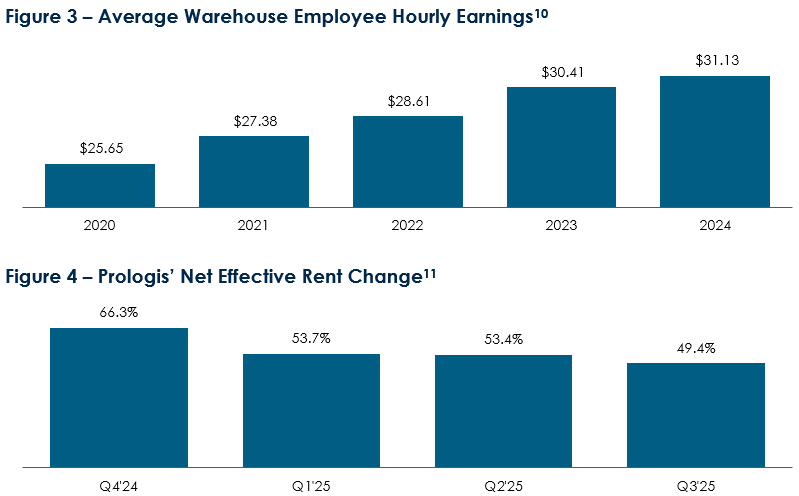
The North American total addressable market for VAW services is in excess of $250 billion[9]. This market is dominated by small, regional participants with few providers commanding a meaningful share of total industry revenue. This fragmentation could create significant competitive opportunities for those with scale. Small regional providers often lack the internal engineering processes to effectively design complex client projects. Smaller players are also less likely to have invested in sophisticated technological systems that allow for more robust analytics and customized reporting that clients are increasingly requiring. Finally, providers with scale are much better positioned to manage through the largest cost categories that present the greatest potential for margin compression: labor and real estate. In Figures 3 and 4, we highlight recent U.S. trends in hourly labor rates for warehouse employees and the average rate of increase at lease maturity for Prologis across its U.S. warehousing property portfolio, respectively.
Graph 2

For providers without a scaled human resources function (or negotiating power with staffing agencies) or relationships with national landlords, cost pressures have been acute in recent times[12].

Potential for M&A in the Value-Added Warehousing Sector

Sub-scale providers are often the perfect M&A targets for strategics pursuing a consolidation effort in the sector. The valuation discrepancy between a provider with scale (>$10m EBITDA) and a smaller provider (<$5m EBITDA) on an EV / EBITDA multiple basis can be substantial given the difference in risk. When executed effectively, M&A helps strategic acquirers enter new services or geographies, gain exposure to new customers and end markets, and bring on additional talent. Cost synergies for transformative transactions are potentially meaningful, but in bolt-on transactions tend to be more limited. That said, relative to other areas of logistics, integration risks are more limited given individual facility operations are semi-autonomous in nature.

Ability to Capture Efficiencies from Automation in VAW Market

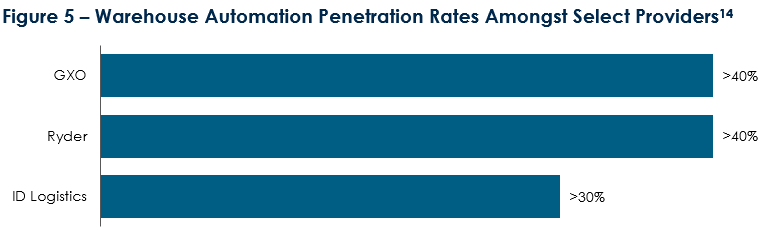
Ongoing innovations in automation tools have helped to dramatically improve labor efficiencies for providers that are able to effectively implement and utilize such technologies. While costly, automation is becoming increasingly common, further deepening the potential competitive moats for those with scale. According to the International Federation of Robotics, the market for industrial robots more than doubled over the course of the last decade to 542,000 installations in 2024, driven by new user adoption[13]. As shown in Figure 5, large public providers are implementing automation technologies in situations where both the economic and use case are viable. In the years ahead, this penetration rate could grow materially as innovation comes to areas of the Value-Added Warehousing market where no solution exists today, such as bulk pallet storage and handling.
Graph 3

Key Diligence Areas: Understanding Risk in VAW Market

Despite this attractive backdrop, there are risks that are unique to the Value-Added Warehousing space that need to be properly reviewed and understood. High levels of customer concentration are common in the sector, so understanding a target’s relationship with its key customers is critical. Mismatches in facility lease terms with key customer contract maturity is another common area of focus in business diligence. Finally, given the duration of contracts are typically multi-year, understanding the mechanisms to offset areas of cost inflation that providers are likely to experience over the life of a client engagement, such as in labor or leases, are important for understanding contract economics.

Stephens VAW Experience

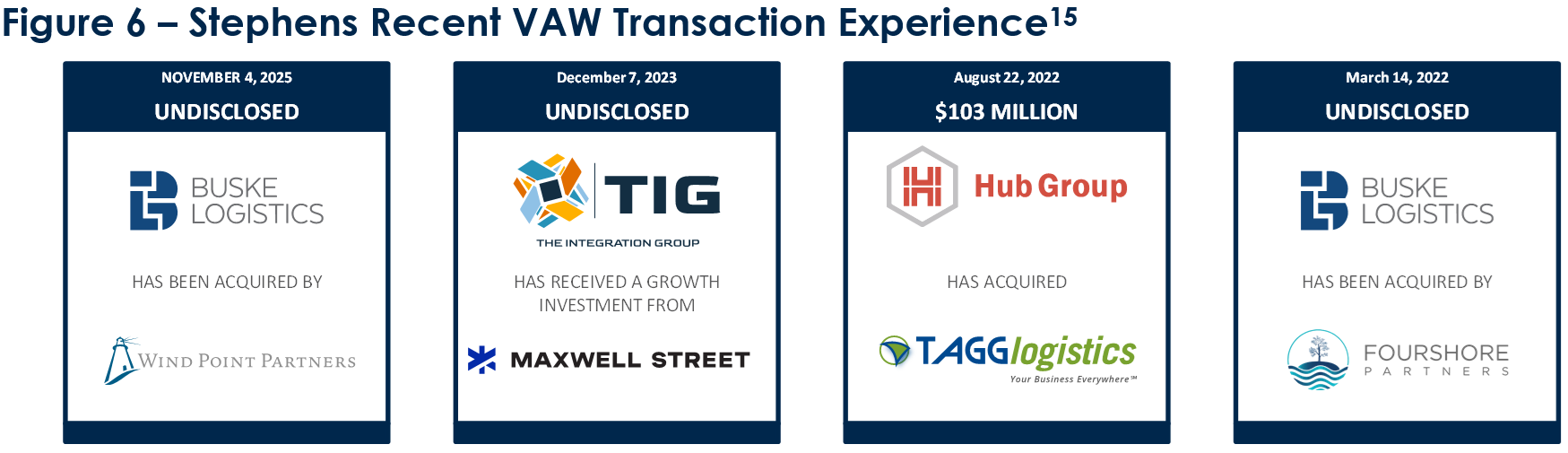
Over the course of the last ~15 years, Stephens has built a market leading Value-Added Warehousing and contract logistics practice, closing over 10 transactions in the sub-sector.

Stephens Investment Banking: Transportation & Logistics
tombstone with title


For more information on Stephens’ capabilities and experience in the VAW sub-sector, please contact either of the authors below:

About the Experts

Michael Miller

Managing Director, Head of Transportation & Logistics, Investment Banking

Read full bio

Connor Hustava

Managing Director, Investment Banking

Read full bio

  1. 1 Source: GXO Logistics 2023 Investor Day materials. 2 Source: https://www.cbre.com/insights/briefs/ecommerces-impact-on-industrial-real-estate-demand. 3 Source: GXO Logistics 2023 Investor Day materials. 4 Source: GXO Logistics 2023 Investor Day materials. 5 Source: GXO Logistics 2023 Investor Day materials. 6 Source: GXO Logistics 2023 Investor Day materials. 7 Source: Public filings and press releases. VAW (GXO, ULH Contract Logistics Segment, CVLG Warehouse Segment), TL (KNX, WERN, HTLD), LTL (XPO, ODFL, SAIA) and Broker (CHRW NAST Segment, LSTR, JBHT ICS Segment). Please see the disclosure at the back of this communication for a description of the methodology used by the Stephens T&L Investment Banking industry team to categorize companies or segments of companies by sub-sector within the T&L industry. 8 Source: Public filings and press releases. VAW (GXO, ULH Contract Logistics Segment, CVLG Warehouse Segment), LTL (XPO, ODFL, SAIA), Broker (CHRW NAST Segment, LSTR, JBHT ICS Segment) and TL (KNX, WERN, HTLD). Please see the disclosure at the back of this communication for a description of the methodology used by the Stephens T&L Investment Banking industry team to categorize companies or segments of companies by sub-sector within the T&L industry. 9 Source: GXO Logistics 3Q25 earnings call. 10 Source: FRED Average Hourly Earnings of Transportation and Warehousing Employees, USD per Hour, Seasonally Adjusted. 11 Represents the percentage change in net effective rental rates (average rate over the lease term), on new and renewed leases, commenced during the period compared with the previous net effective rental rates in that same space. This measure excludes any short-term leases of less than one year and holdover payments. 12 https://www.prologis.com/insights-news/industry-trends/labor-challenges-strategies-warehouse-labor-planning. 13 Source: https://ifr.org/ifr-press-releases/news/global-robot-demand-in-factories-doubles-over-10-years. 14 Source: Public filings and press releases (GXO, R, IDL.PA). 15 These transactions reflect those of where Stephens served as Financial Advisor. The Stephens T&L Investment Banking industry team selected the companies or segments of companies included in the VAW, TL, LTL and Broker sub-sectors within the T&L industry based upon the team’s perception of each company’s or segment’s primary area of focus. In forming this view, the team considered a company’s or segment’s description of its business and product pipeline, publicly-available disclosures and the team’s perception of the extent to which each company or segment derives the bulk of its revenue from operating within that sub-sector. The components of each sub-sector currently consist of the following: VAW (GXO, ULH Contract Logistics Segment, CVLG Warehouse Segment), TL (KNX, WERN, HTLD), LTL (XPO, ODFL, SAIA) and Broker (CHRW NAST Segment, LSTR, JBHT ICS Segment). The components of each sub-sector may be updated periodically to reflect the addition of companies or segments of companies that, in the view of the Stephens T&L Investment Banking industry team, are more representative of such sub-sector than other companies or segments, and/or the removal of companies or segments that, in the view of the Stephens T&L Investment Banking industry team, are not as representative of these business sub-sectors as other companies or segments. These sub-sectors are intended solely to illustrate performance trends of the companies or segments of companies within these business sub-sectors. The performance of individual companies or segments within a sub-sector may differ significantly from that of the sub-sector as a whole. These sub-sectors are not investment vehicles, funds or other financial products and are not designed or available for direct investment. They should not be interpreted as a recommendation to sell or buy any securities, nor should they be used as the basis for any investment decision. All data presented related to these sub-sectors is provided strictly for illustrative purposes. Past performance or hypothetical past performance is not indicative of future results. This communication has been prepared by Stephens’ Investment Banking Department for informational purposes only for distribution to clients and prospective clients. It is not a solicitation, recommendation or offer to buy or sell any security and does not provide information on which an investment decision to purchase or sell any securities could be based. It does not purport to be a complete description of the securities, markets or developments referred to in this communication. This communication is not a research report, was not prepared by Stephens’ Research Department or by any research analysts or other persons licensed or qualified as research analysts, is not subject to the same rules and procedures as a research report, is not intended to provide a sufficient basis for an investment decision, is not intended for distribution to any retail customers and should not be considered a research report. Stephens does not make (and is prohibited from making) any promise of favorable research coverage. Any views expressed in this communication may differ from those of Stephens or of Stephens’ Research Department. Information included in this communication was obtained from sources considered to be reliable, but Stephens has not independently verified such information and does not guarantee that it is accurate or complete. No representation or warranty, express or implied, is made as to the accuracy, completeness, or correctness of any such information. To the full extent permitted by law, neither Stephens nor any other person accepts any liability whatsoever for any direct, or indirect or consequential loss or damage arising from any use of the information contained in this communication. No subsequent publication or distribution of this communication shall mean or imply that any such information remains current at any time after the date of preparation of this communication. Stephens does not undertake to advise you of any changes in any such information. Additional information is available upon request. Please assume that Stephens or its employees or affiliates hold long or short positions in any of the securities mentioned, and at any time may sell or buy any such securities, make a market in any such securities, conduct underwritings for any such securities or provide other investment banking services involving any of such securities. The views and opinions expressed in this communication are those of the author, or the person(s) to whom such view or opinion is attributed, and do not necessarily reflect the opinions of Stephens or any other person or entity. Any expressions of opinion or forward-looking statements included in this communication are based on information available on the date of preparation, speak only as of such date and are subject to change without notice. No assurance can be given that any of such opinions or statements will prove correct. Artificial intelligence tools are often used in the preparation of communications and other materials prepared by Stephens’ Investment Banking Department, including assisting in data analysis, pattern recognition, and content drafting for such communications and other materials. Nothing in this communication should be viewed as accounting, tax, regulatory or legal advice; please contact your professional accounting, tax, regulatory or legal advisors for such advice. Data referenced in this communication has been sourced from company announcements and from the third-party data sources or data providers cited in this communication, including, but not limited to, S&P Global Market Intelligence and/or its Affiliates (Copyright © 2025 S&P Global Market Intelligence and/or its Affiliates. All Rights Reserved. Reprinted with permission of S&P Global Market Intelligence, Bloomberg Finance L.P. and PitchBook Data Inc. – [Data has not been reviewed by PitchBook analysts or any other external reviewer”] (collectively “Data Providers”). Unless otherwise explicitly stated, any financial data regarding a company or an industry included in this communication reflects historical financial data or estimates of future performance obtained from third party sources. All financial metrics, ratios and estimates included in this communication have been sourced from the Data Providers and other sources cited in this communication or reflect calculations based upon data sourced from the Data Providers and other sources cited in this communication. Please note that Data Providers and other sources cited in this communication do not guarantee the accuracy, adequacy, completeness or availability of any content provided and are not responsible for any errors or omissions, regardless of the cause, or for the results obtained from the use of such content. In no event shall the Data Providers or any other sources cited in this communication or Stephens be liable for any damages, costs, expenses, legal fees or losses in connection with any use of the data and/or financial materials included in this communication. “Stephens” (the company brand name) is a leading family-owned investment firm that includes Stephens Inc. (member NYSE/SIPC), Stephens Investment Management Group, LLC, Stephens Insurance, LLC, Stephens Capital Partners LLC and Stephens Europe Limited (Registered office: 12 Arthur Street, London, EC4R 9AB, Registered number 8817024), which is authorised and regulated by the Financial Conduct Authority. © 2025 Stephens