
Stephens

Stephens will never ask clients or prospective clients for personal or financial information, or provide investment advice, via social media, or WhatsApp.

If you have any questions or concerns about someone from Stephens contacting you, please call your Stephens Representative or reach out to us via our Contact Us form.

Who We Are

What We Do

We provide investment banking, research, sales and trading, asset and wealth management, public finance, insurance, private capital, and family office services.

About Us

We are a family-owned financial services firm that values client relationships, long-term stability, and supporting the communities where we live and work.

The Stephens Story

The idea of family defines our culture, because each of us knows that our reputation is on the line as if our own name was on the door.

Leadership

Our reputation as a leading independent financial services firm is built on the stability of our longstanding and highly experienced senior executives.

Impact Initiatives

We are committed to bettering the communities where we live and operate. We do this by supporting corporate philanthropy, economic and financial literacy advocacy, and professional success.

Our Brand Ambassadors

Stephens is proud to sponsor the PGA TOUR, LPGA Tour, and PGA TOUR Champions careers, as well as applaud the philanthropic endeavors, of our Brand Ambassadors.

Stephens & Atlassian Williams F1 Team

Stephens is the official investment banking partner of Williams Racing, one of the most winning teams in F1 history. We share that tradition of success.

Making Connections

We host many highly informative meetings each year with clients, industry decision makers, and thought leaders across the U.S. and in Europe.

Article Icon

Market Trends

Corporate Divestiture Guide for the Transportation & Logistics Sector

Apr 10, 2026

Corporate Divestiture Guide for the Transportation & Logistics Sector

On the heels of recent T&L sector volatility, corporations are sharpening focus on their core lines of business. Going forward, we believe corporate divestiture activity (or “carve-outs” as referred to in this analysis) may become an increasingly important strategic lever for value creation.

When considering a divestiture, a number of factors should be evaluated, as detailed below, including the recognition that separation value extends beyond the headline purchase price. Disciplined planning can reduce separation cost and effort, while potentially improving transaction certainty and maximizing net proceeds.

When a Company Should Consider a Divestiture

When undertaking a strategic review to ascertain whether a division is a divestiture candidate, the following high-level questions are a helpful test for boards and
management teams to evaluate whether continued ownership and investment into a business line makes sense:

  • Is the business unit strategic to the Parent’s long-term plan?
  • How would a divestiture impact ongoing customer and vendor relationships for the
    remaining company (positive or negative)?
  • Does the business unit have sufficient scale/can it effectively compete over the long
    term?
  • How standalone is the business today (customers, people, systems, assets)?
  • Is the current market value to a buyer greater than the expected future contribution to
    the Parent?
  • What dis-synergies are likely to be incurred by the remaining business, and are they
    able to be eliminated over time?
  • What level of investment is required to grow the business? Are there higher returns for
    that capital elsewhere in the other businesses?
  • Are there any pending regulatory changes that will change the competitive
    landscape?
  • For public companies, how will investors perceive the sale, and will the investor relations
    story meaningfully change?

Once a Parent company deems a business non-core, taking action to develop a divestiture plan is critical. In our experience, business segments deemed non-core are typically under-resourced, suffer from elevated turnover and low morale, become less competitive, and, therefore, value erodes over time. Proactive divestitures can strengthen strategic focus, improve capital allocation and returns, and support a clearer ownership narrative.

Sell-side Guide – Investing in Preparation is Critical to Unlocking Value

Divestitures are more complex and time-consuming than regular-way M&A. Rigorous preparation is paramount to create a market-ready opportunity with a clear transaction perimeter, clean financials, and an executable separation plan.

As a best practice, the Parent company should assemble a team of 3rd party advisors with carve-out experience to support value optimization, efficient execution, and certainty of a transaction, while reducing ongoing support burdens and operating limitations of the Parent. A typical 3rd party advisory team to support a carve-out transaction would include the groups below, each with their own area of focus:
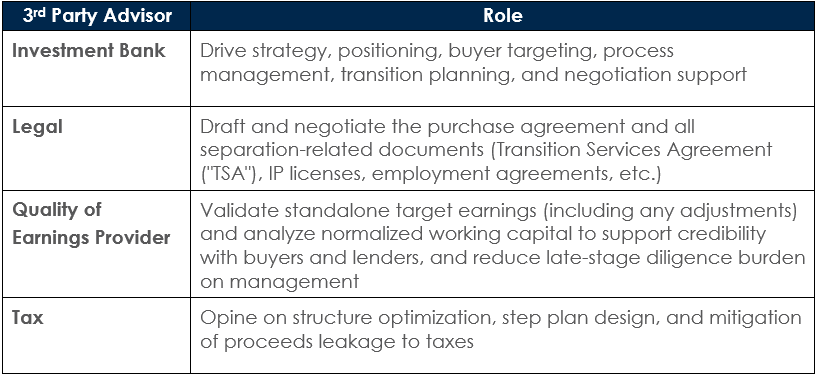
whitepaper table 1

Key Steps in Preparing for a Corporate Carve-out Transaction

Step 1: Defining a Transaction Perimeter and Establishing a Separation Plan

At the onset of considering a divestiture, the initial focus needs to be on establishing a transaction perimeter, which involves identifying the key components of the business that will transfer to a new owner. In parallel, the Parent should begin building an executable separation plan that defines how the business will operate on Day 1 and how remaining dependencies on the Parent will be unwound post-closing. Developed together, these two workstreams could reduce buyer uncertainty, support credible carve-out financials, and possibly minimize late-stage surprises that can drive delays or re-trades.

Standard transaction perimeter items to consider include:

  • Assets and liabilities transferring (including working capital items)
  • In-scope legal entities, IP, and trademarks/branding
  • Real estate, leases, and equipment (as applicable)
  • In-scope employees
  • Key customer and vendor contracts (and required consents)
  • Proprietary technology, infrastructure, and IT support

Separation plan components that the Parent should focus on include:

  • Stranded Costs: Identify fixed costs that cannot be transferred to the divested business, which reduce go-forward economies of scale for Parent, and mitigate where possible.
  • Commercial Agreements and Contracts: Identify shared agreements and, where possible, begin separating into division-level agreements in advance.
  • HR and Benefits: Develop an employee go-forward strategy, including benefit plan review, open enrollment timing, and communication plans.
  • Legal and Tax: Entity structuring, separation steps, and tax planning aligned to the transaction structure.
  • Intercompany Arrangements: Map intercompany revenue, cost-sharing, and service agreements, and put in place replacement contracts and commercial processes at close to avoid disruption.

Step 2: Preparing Clean Financials

Once a perimeter and a separation plan have been established, the Parent's focus should shift to preparing pro forma financial statements for in-scope operations. The financials should reflect the revenues and costs associated with all perimeter-defining items, as well as requisite standalone costs. For a portion of the financial statement line items, this is often as straightforward as revised general ledger and trial balance mapping; however, for other line items, such as corporate overhead, contemplating allocation methodologies in detail is necessary to produce marketing-ready, clean financials. Sellers should also give early attention to pro forma personnel costs, including any headcount additions required to replace shared services, and benefits normalization where the divested business has historically participated in Parent-level plans. These adjustments are often assumption-based and, as a result, can drive re-trades or disagreements on standalone earnings if poorly considered. Ultimately, buyers will expect corporate support expenses to reflect true cash costs as opposed to some other internal accounting methodology (i.e., percentage of revenue). Corporate cost allocations often take considerable time and thought to keep assumption-based expenses logical and defensible during buyer diligence.

Step 3: Drafting the TSA Services Schedule

The TSA is a contract under which the Parent provides specified transitional services to the divested business beginning Day 1 and continuing for a defined period. The TSA typically sets the scope of services, service standards, pricing, governance, and an exit timeline as the divested business stands up standalone capabilities. Although the TSA agreement and its details will be primarily drafted and negotiated during the process, planning ahead for the services a buyer may require is critical to effectuating a seamless transition of ownership from the Parent. For this exercise, Parent should develop a preliminary list of services currently provided by the Parent to the divested entity that will still be required post-close, together with descriptions of those services, the required personnel, the cost to deliver, and an estimated separation timeline. In our experience, being prepared with a well-formed TSA services schedule often minimizes timing delays and value leakage associated with an expanded scope of services post-close.

Key Stumbling Blocks to Avoid: Common issues that could derail carve-out transactions or cause value leakage:

  • Unclear Transaction Perimeter: Marketing or diligencing a potential transaction without a clear transaction perimeter is one of the most common failure points in a carve-out or divestiture, often resulting in wasted diligence time on entities that could be in the transaction, and often leading to unforeseen tax impacts.
  • TSA Scope Creep: Scope creep can emerge both in drafting and through the transition period. Buyers may push to expand services beyond what is operationally necessary or extend durations through initial terms and renewal options, ultimately distracting the Parent's employee base and/or forcing it to provide services at a loss.
  • Contract Overlap: Key customer and vendor agreements are often shared across multiple business units within the Parent – waiting until in a process to separate agreements creates delays and/or leads to a complex TSA arrangement post-close.
  • Employee Attrition and Information Leaks: Without clear retention incentives and confidentiality controls, carve-outs can quickly devolve into employee uncertainty, leadership turnover, and internal or external information leaks – all of which distract the business and may unnecessarily pressure value.
  • Timing Disruptions: Lack of process continuity and lost momentum in a transaction could negatively impact operations, burn out management, and cause a buyer to second guess its thesis.
  • Parent Non-compete: Non-compete language in the purchase agreement is standard protection for a buyer. Appropriately tailoring such language to avoid go-forward impediments to the Parent is critical for post-transaction continuity.

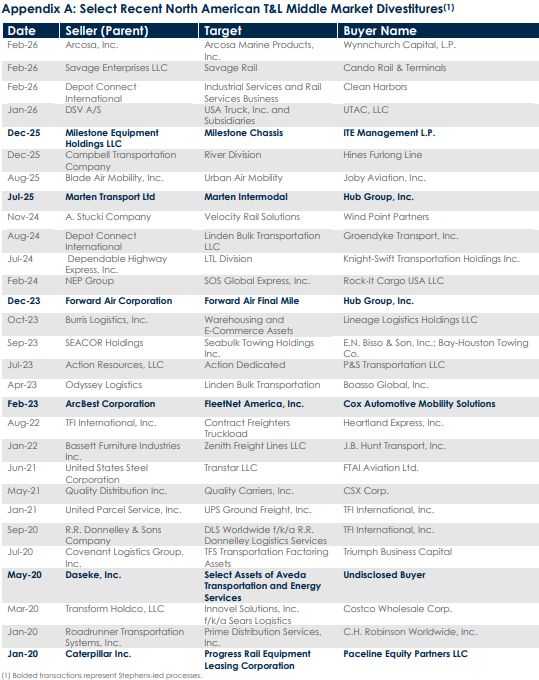
Stephens’ Carve-out & Divestiture Experience: Over the course of the last ~15 years, Stephens’ T&L group has built one of the leading carve-out and divestiture advisory practices.
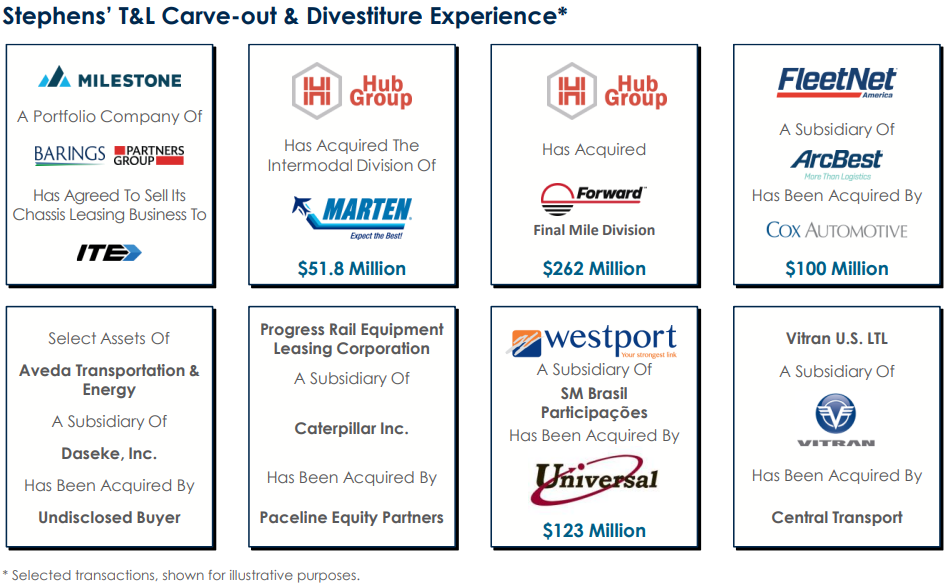
Tombstones for whitepaper


whitepaper table

For more information on Stephens’ divestiture and carve-out capabilities, please contact any of the authors below:


About the Experts

Michael Miller

Managing Director, Head of Transportation & Logistics, Investment Banking

Read full bio

Connor Hustava

Managing Director, Investment Banking

Read full bio

Marshall McKissack

Managing Director, Head of M&A Advisory, Investment Banking

Read full bio

Jacob Evans

Vice President, Investment Banking

Read full bio

  1. This communication has been prepared by Stephens’ Investment Banking Department for informational purposes only for distribution to clients and prospective clients. It is not a solicitation, recommendation or offer to buy or sell any security and does not provide information on which an investment decision to purchase or sell any securities could be based. It does not purport to be a complete description of the securities, markets or developments referred to in this communication. This communication is not a research report, was not prepared by Stephens’ Research Department or by any research analysts or other persons licensed or qualified as research analysts, is not subject to the same rules and procedures as a research report, is not intended to provide a sufficient basis for an investment decision, is not intended for distribution to any retail customers and should not be considered a research report. Stephens does not make (and is prohibited from making) any promise of favorable research coverage. Any views expressed in this communication may differ from those of Stephens or of Stephens’ Research Department. Information included in this communication was obtained from sources considered to be reliable, but Stephens has not independently verified such information and does not guarantee that it is accurate or complete. No representation or warranty, express or implied, is made as to the accuracy, completeness, or correctness of any such information. To the full extent permitted by law, neither Stephens nor any other person accepts any liability whatsoever for any direct, or indirect or consequential loss or damage arising from any use of the information contained in this communication. No subsequent publication or distribution of this communication shall mean or imply that any such information remains current at any time after the date of preparation of this communication. Stephens does not undertake to advise you of any changes in any such information. Additional information is available upon request. Please assume that Stephens or its employees or affiliates hold long or short positions in any of the securities mentioned, and at any time may sell or buy any such securities, make a market in any such securities, conduct underwritings for any such securities or provide other investment banking services involving any of such securities. The views and opinions expressed in this communication are those of the author, or the person(s) to whom such view or opinion is attributed, and do not necessarily reflect the opinions of Stephens or any other person or entity. Any expressions of opinion or forward-looking statements included in this communication are based on information available on the date of preparation, speak only as of such date and are subject to change without notice. No assurance can be given that any of such opinions or statements will prove correct. Past performance is not indicative of future results. Artificial intelligence tools are often used in the preparation of communications and other materials prepared by Stephens’ Investment Banking Department, including assisting in data analysis, pattern recognition, and content drafting for such communications and other materials. Nothing in this communication should be viewed as accounting, tax, regulatory or legal advice; please contact your professional accounting, tax, regulatory or legal advisors for such advice. Data referenced in this communication has been sourced from company announcements and from the third-party data sources or data providers cited in this communication, including, but not limited to, S&P Global Market Intelligence and/or its Affiliates (Copyright © 2026 S&P Global Market Intelligence and/or its Affiliates. All Rights Reserved. Reprinted with permission of S&P Global Market Intelligence, Bloomberg Finance L.P. and PitchBook Data Inc. – [Data has not been reviewed by PitchBook analysts or any other external reviewer”] (collectively “Data Providers”). Unless otherwise explicitly stated, any financial data regarding a company or an industry included in this communication reflects historical financial data or estimates of future performance obtained from third party sources. All financial metrics, ratios and estimates included in this communication have been sourced from the Data Providers and other sources cited in this communication or reflect calculations based upon data sourced from the Data Providers and other sources cited in this communication. Please note that Data Providers and other sources cited in this communication do not guarantee the accuracy, adequacy, completeness or availability of any content provided and are not responsible for any errors or omissions, regardless of the cause, or for the results obtained from the use of such content. In no event shall the Data Providers or any other sources cited in this communication or Stephens be liable for any damages, costs, expenses, legal fees or losses in connection with any use of the data and/or financial materials included in this communication. “Stephens” (the company brand name) is a leading family-owned investment firm that includes Stephens Inc. (member NYSE/SIPC), Stephens Investment Management Group, LLC, Stephens Insurance, LLC, Stephens Capital Partners LLC and Stephens Europe Limited (Registered office: 12 Arthur Street, London, EC4R 9AB, Registered number 8817024), which is authorised and regulated by the Financial Conduct Authority. © 2026 Stephens